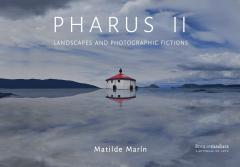
Pharus II
When the eye narrates and deviates
Francisco Marguch
In Pharus II. Landscapes and Photographic Fictions Matilde Marín embarks (literally) on a visual journey that documents and recreates lighthouses of the world. It is Marín's second work that Bosquemadura E-DITORIAL DE ARTE publishes to offer us other perspectives that in some way redefine that first ebook: Pharus. From the Southern to the Northern Hemisphere (2021). This work takes the reader on a journey in images, maps and seas, which begins in the austral extremes of Argentina and stops at various coastal locations until reaching boreal regions, offering an aesthetic and reflective experience.
Pharus II. Landscapes and Photographic Fictions makes the opposite route to that first book: it is the return home, going from the East and the North to the South and West. The second digital book makes the eye tense: the image orients and also disorients, invites to deviation. In this journey –through documentary and fictional images– Marín presents lighthouses that are not only physical guides in the sea, but which, through their visual aspect, now reveal spaces of fascination for imagining new stories that revitalize those symbols of memory and history.
In her essay –March, sail, travel, without fear of storms. Pharus photographic alchemy–, Laura Malosetti Costa points out that the photographs of the lighthouses, especially those in the first part of the book, in black and white, although austere in terms of adjectives, evoke concepts and narratives such as those of the journey, the shipwreck, the tragedy. The photographs of the lighthouses, with their immensity and symbolism, open the vision to colour and break the expected, creating a sort of dreamlike atmosphere that pushes and allows us to perceive the movement of an almost cinematic world. Adriana Musitano’s essay, From the mise-en-abyme to other landscapes…, reflects on these aspects, thinking of the surrealist image as a fruitful reading paradigm to learn more about these new creations by Marín. Speaking of the surrealist image, André Breton tells us:
I do not hide the fact that for me the most powerful image is the one that presents the highest degree of arbitrariness; the one that requires the longest time to be translated into practical language, whether it conceals an enormous dose of apparent contradiction, whether one of its terms has been curiously concealed, whether it is announced in a sensational way and ends up being weakly resolved (suddenly closing the angle of its compass), whether it deduces from itself a derisory formal justification, whether it enters into the hallucinatory order, or because, with the greatest naturalness, it lends the abstract the mask of the concrete or vice versa, whether it implies the denial of some physical property (Breton, 1963: 53. Italics are ours).
Where the lights are born
Matilde Marín
In November 2005 I arrived at Cabo Magallanes Lighthouse, at the southern tip of what many call the last corner of the continent. There, the Atlantic and Pacific oceans dramatically mix, transforming their colors into a changing spectacle. The lighthouse that guards this peninsula is robust and its interior, from where the light is projected to the ocean, has the beauty of its function, in which it spins, illuminates and reflects. In that remote corner of Southern Patagonia, I expressed the idea of creating the Pharus Project Series.